LLM Integration Services

Model-agnostic AI Architecture. Built for Precision. Shipped for Production.

We integrate all major AI platforms into your enterprise product and infrastructure. Model-agnostic by design and production-grade by delivery. From Claude GPT Gemini integration to multi-agent AI system integration, we handle every layer.

banner image
What we build

Full-Stack LLM Integration Across All Three Major Platforms

From model selection through prompt engineering, RAG pipelines, OCR, tool use, and production deployment, our AI model integration services handle every layer. You get a system that works, scales, and delivers.

LLM Selection & Architecture Advisory

LLM Selection & Architecture Advisory

Choosing the wrong model at enterprise scale isn’t a small mistake; it’s a compounding cost. Terralogic benchmarks LLMs against your actual use case and decides based on real-world performance across latency, cost per call, accuracy, and compliance at scale.

Model BenchmarkingCost ModellingLatency ProfilingData Residency
Prompt Engineering & System Design

Prompt Engineering & System Design

Production-grade AI is engineered, not written. Terralogic designs system prompts, few-shot examples, chain-of-thought structures, and output schemas that ensure your LLM consistently produces reliable and usable outputs—the foundation of LLM integration services.

System Prompt DesignFew-Shot EngineeringOutput SchemasGuardrail Design
Multimodal OCR Pipelines

Multimodal OCR Pipelines

Stop ‘reading’ documents. Start ingesting intelligence. Terralogic builds end-to-end document extraction pipelines for high-volume processing and complex reasoning. Our LLM integration for document processing ingests PDFs, scanned images, and handwritten forms, outputting clean, structured JSON.

Gemini 2.5 FlashPro (Vertex AI) InvoiceContractForm ExtractionConfidence RoutingGoogle Document AI
Retrieval-Augmented Generation (RAG)

Retrieval-Augmented Generation (RAG)

LLMs hallucinate on proprietary data. RAG fixes that. Our RAG pipeline development service covers end-to-end retrieval systems: document ingestion, chunking, vector embedding, semantic search with reranking, and context injection. All from your data, with sources cited.

PineconeWeaviatePgvectorVertex AI EmbeddingsHybrid searchReranking
Tool Use, Function Calling & MCP

Tool Use, Function Calling & MCP

AI that acts doesn't just respond. Terralogic allows LLMs to interact with your systems through function calling, MCP servers, and tool orchestration, triggering workflows, fetching data, and executing real actions inside your business. This drives our multi-agent AI system integration.

OpenAI Function CallingChainingMCPGemini Function-Calling
Production Deployment & Monitoring

Production Deployment & Monitoring

A working demo is easy. A reliable production system isn’t. Terralogic builds AI systems that operate under real-world conditions with observability, cost control, performance tracking, and fallback strategies across multiple models. Launch AI confidently.

LangSmithLangfuseToken Cost Tracking Per ModelMulti-model fallback chainsVertex AI monitoring
Model Comparison

Claude · GPT-4o · Gemini An Equal, Honest Comparison

Our Claude GPT Gemini integration practice is model-agnostic by design. Each platform has genuine strengths. We recommend the right one, or a routing architecture using multiple models based on what you're actually building.

Reasoning & agents

Claude

Sonnet 4.6.Opus 4.6

Best for: complex multi-step reasoning, long document analysis, agentic workflows, regulated industries needing low hallucination rates. Has native MCP support – the cleanest integration for tool-using agents.

MULTIMODAL & CODE

GPT-4o

Sonnet 4.6.Opus 4.6

Best for: vision nd audio multimodal tasks, code generation, Microsoft 365-heavy environments, teams with existing OpenAI integrations. Strongest ecosystem of third-party tooling.

ocr. Scale. google stack

Gemini 2.5

Sonnet 4.6.Opus 4.6

Best for: high-volume document and multimodal processing, Google Worspace-native integrations, multimodal + reasoning workflows. 1M token context window on Pro.

Reasoning & agents

Claude

Sonnet 4.6.Opus 4.6

Best for: complex multi-step reasoning, long document analysis, agentic workflows, regulated industries needing low hallucination rates. Has native MCP support – the cleanest integration for tool-using agents.

MULTIMODAL & CODE

GPT-4o

Sonnet 4.6.Opus 4.6

Best for: vision nd audio multimodal tasks, code generation, Microsoft 365-heavy environments, teams with existing OpenAI integrations. Strongest ecosystem of third-party tooling.

ocr. Scale. google stack

Gemini 2.5

Sonnet 4.6.Opus 4.6

Best for: high-volume document and multimodal processing, Google Worspace-native integrations, multimodal + reasoning workflows. 1M token context window on Pro.

Why choose us?

We move fast because we've built LLM systems before across all platforms. Every enterprise LLM integration engagement starts with your real problem and is engineered to solve it.

Week 01

Discovery & Architecture

We map your use case, data sources, and constraints; benchmark LLMs against your specific requirements, document types, accuracy needs, volume, latency, and cost model; and recommend a model that works for you.

Weeks 02–06

Prompt Design & Integration Build

We design and test prompts in parallel with building the backend integration. For agents: tool definitions, MCP integration, orchestration logic. All are validated against real data, not synthetic tests.

Week 07-08

Evaluation & Hardening

Structured evaluation against your real use cases. For OCR, accuracy on your specific document formats is validated. Guardrails added. Load testing completed before production sign-off.

Week 09

Production Deployment & Handover

Deploy to your cloud infrastructure for full observability: per-model cost tracking, latency dashboards, confidence routing logs, and fallback monitoring. Complete documentation and team handover.

We have covered all industries across the domain

From startups to known brands we have many stories to tell

Real EstateReal Estate
AccountingAccounting
FintechFintech
HealthcareHealthcare
RetailRetail
InsuranceInsurance
AutomotiveAutomotive
GovernmentGovernment
EdutechEdutech
ManufacturingManufacturing
SM BusinessSM Business
E-CommerceE-Commerce
FREQUENTLY ASKED

Questions

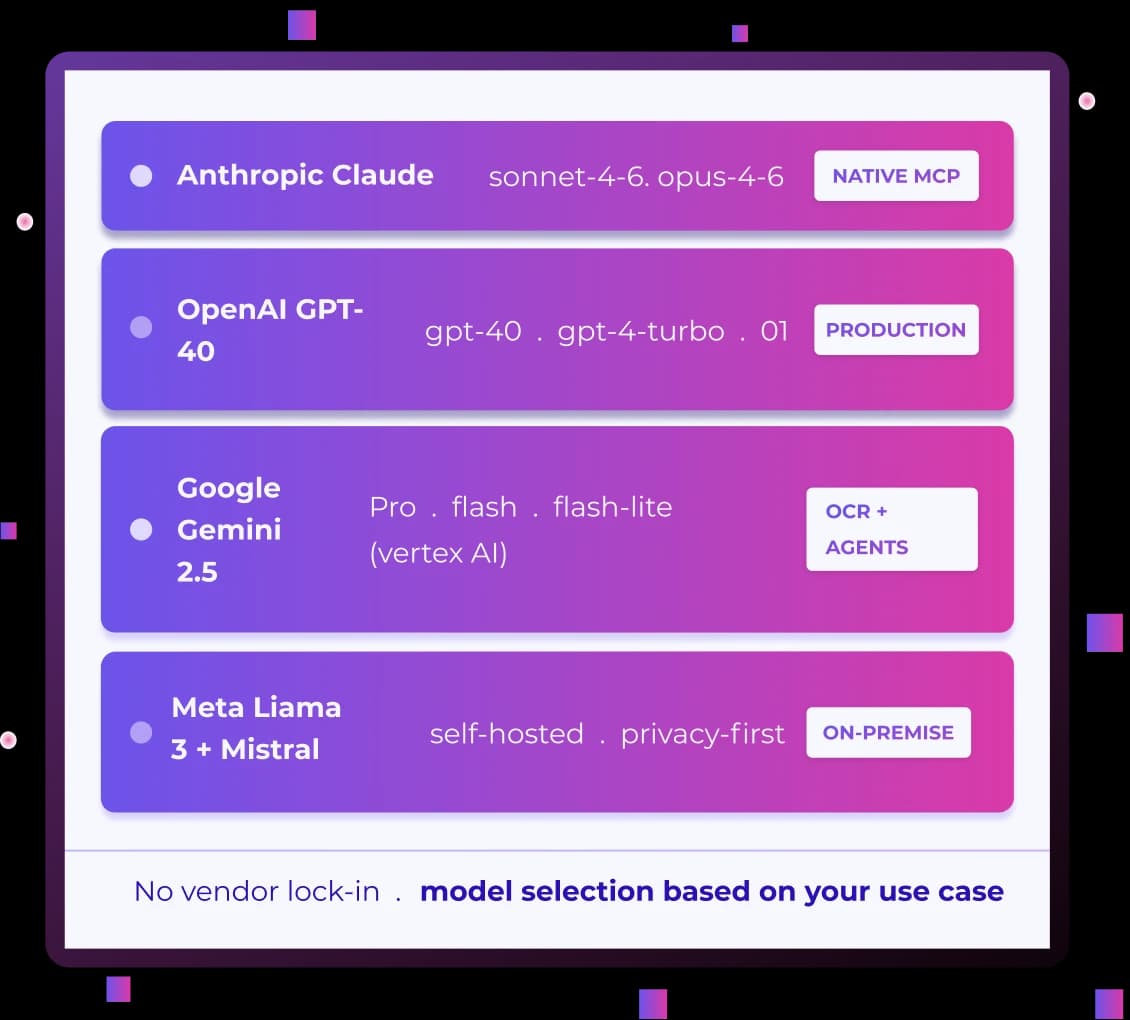
Terralogic integrates three LLM models: Anthropic Claude (Sonnet 4.6, Opus 4.6), OpenAI GPT-4o and GPT-4 Turbo, and Google Gemini 2.5 Pro and Gemini 2.5 Flash on Vertex AI. Additionally, Terralogic integrates Meta Llama 3 (self-hosted, 70B and 8B) and Mistral for specialist use cases. The recommendation is always based on the client’s use case, data privacy requirements, cost model, and existing infrastructure.
When it comes to high-volume document processing, Gemini 2.5 Flash on Vertex AI is Google’s most capable multimodal model. Its architecture handles PDFs, scanned images, handwritten text, and structured tables in a single inference pass without a separate OCR step. Much simpler than traditional 2-step pipelines. For complex documents that require deep reasoning, Gemini 2.5 pro delivers accurate extraction with a 1M token context window. Terralogic uses both in production based on the document’s complexity and confidence thresholds.
It depends on the job. Each has distinct strengths. Claude (Anthropic) is best for complex reasoning, long document analysis, agentic workflows, and regulated industries needing low hallucination rates. It has native MCP support. GPT-4o (OpenAI) is an all-rounder for multimodal tasks (vision + audio), code generation, and Microsoft ecosystem environments. Google Gemini 2.5 Flash is the best choice for high-volume document and multimodal processing pipelines, and Gemini 2.5 Pro is competitive with Claude for reasoning-heavy tasks with a 1M token context window and strong Google Workspace integration. Terralogic runs model benchmarking during the Discovery phase before recommending a production architecture, which often involves routing different task types to different models.
Yes. Google Gemini on Vertex AI provides high-end security, data residency controls, and compliance certifications such as SOC2, ISO 27001, and HIPAA eligibility. We deploy Gemini 2.5 Pro and Flash on Vertex AI with Google OAuth2 and service account authentication and regional data processing.
We move fast because we follow a repeatable framework rather than a “guess-and-check” process. Our Discovery and Architecture phase takes just one week, during which we map your data, select the optimal models—whether that’s Claude, GPT, Gemini, or a custom multi-model routing architecture—and provide a full integration specification with a firm build estimate. From there, the Build and Evaluation phase typically spans 4 to 8 weeks for a single use case or up to 16 weeks for more complex, multi-agent systems. Altogether, you can expect a total timeline of 6 to 12 weeks to move from our first conversation to a fully documented, production-ready deployment that your team can confidently own.
Anthropic models excel at complex reasoning, lengthy document analysis, and multi-step agentic workflows. With native MCP support, they offer tool integration, making them perfect for regulated industries and high-trust environments. Currently, they are adopted in enterprise settings. But for a heavy OCR use case, GPT-4o is the best choice.
OpenAI models are best for multimodal workflows combining text, image, and audio, along with code generation and large-scale function calling. With a 128K context window and strong ecosystem support (especially within Microsoft environments), they are particularly effective for image-heavy OCR tasks that require visual reasoning alongside text extraction. This makes GPT-4o a reliable choice for mixed content processing (image + text). (Cloud deployment via Azure OpenAI.)
Google’s Gemini 2.5 models are optimized for high-volume document processing and multimodal workflows, with a 1M token context window enabling large-scale document handling in a single pass. Gemini 2.5 Flash is ideal for high-throughput extraction, while Gemini 2.5 Pro delivers high accuracy on complex layouts and structured documents. With native integration into Vertex AI and Google Workspace, this is the primary choice for OCR-heavy pipelines. (Cloud deployment via Vertex AI.)
Meta’s Llama 3 models are best suited for fully on-premise deployments, especially in regulated or air-gapped environments where data cannot leave internal infrastructure. With a 128K context window and full control over the inference stack, they offer significant cost advantages at very high volumes. While OCR is possible, it is more complex to implement and optimize compared to cloud-native models, making it better suited for privacy-first rather than OCR-first use cases.
Terralogic is the right partner for teams that have a real business problem and a defined timeline and need LLM integration done end-to-end—not exploratory pilots or slide-deck evaluations.
Terralogic works with product teams looking to integrate AI into existing SaaS products without building an in-house AI team. The focus is on delivering a fully implemented LLM layer, tailored to the use case using models like Claude, GPT-4o, or Gemini, and handing it over in a production-ready, documented state.
Terralogic enables operations and finance teams to handle high-volume document processing (invoices, contracts, and expense forms) with scalable, cost-efficient AI pipelines. For most such use cases, Gemini 2.5 Flash on Vertex AI is recommended for its high accuracy and significantly lower cost compared to traditional OCR systems.
Terralogic helps teams that need to compare models like Claude, GPT-4o, and Gemini in real-world conditions. Instead of theoretical comparisons or vendor demos, Terralogic conducts practical benchmarks and deploys the best-performing solution into production.

Let's Craft Brilliance

Just exploring? Let's think out loud together. We would love to hear from you. Come, let's get started!